
Individual Therapy for Adults in Ontario

For what happened — and everything that came after.
I offer virtual individual psychotherapy for adults across Ontario, working with people from a wide range of backgrounds and with particular experience supporting racialized, immigrant, refugee, diasporic and queer adults, including those navigating third-culture identities and experiences.
BOOK A FREE 15-MINUTE CONSULTATIONWhat Brings People to Therapy
You do not have to be falling apart to begin therapy.
Sometimes you are functioning, working, caring for other people, answering messages, getting through the day — and still carrying something that does not quite let you rest.
People come to therapy for things like:
- Complex trauma, PTSD and childhood trauma, including childhood sexual abuse
- Anxiety, depression, overwhelm, numbness or dissociation
- Grief, complicated loss and difficult life experiences
- Family conflict, relational trauma and intergenerational patterns
- People-pleasing, perfectionism, over-functioning and hyper-independence
- Boundaries, intimacy and relationship patterns that keep repeating
- Migration, displacement, racism and racial or cultural identity
- Queer identity, sexuality, faith and belonging
- Family and cultural expectations
- Major life transitions
- Feeling caught between different versions of home, family, community or self
Sometimes what hurts is deeply personal. Sometimes it was inherited. Sometimes it was shaped by culture, migration, racism, gender, sexuality, family, money, work or the places you have had to learn to survive.
Often, it is all of these at once.
And sometimes the hardest part is that you already understand yourself very well.
You know where the pattern came from. You can name the childhood dynamic. You understand why you shut down, over-explain, stay too long, leave too quickly, anticipate everyone else's needs or struggle to trust rest when it finally arrives.
And your body is still doing what it learned to do.
That is often where the work begins.
The Patterns We Learn to Live By
Most of us become very good at something.
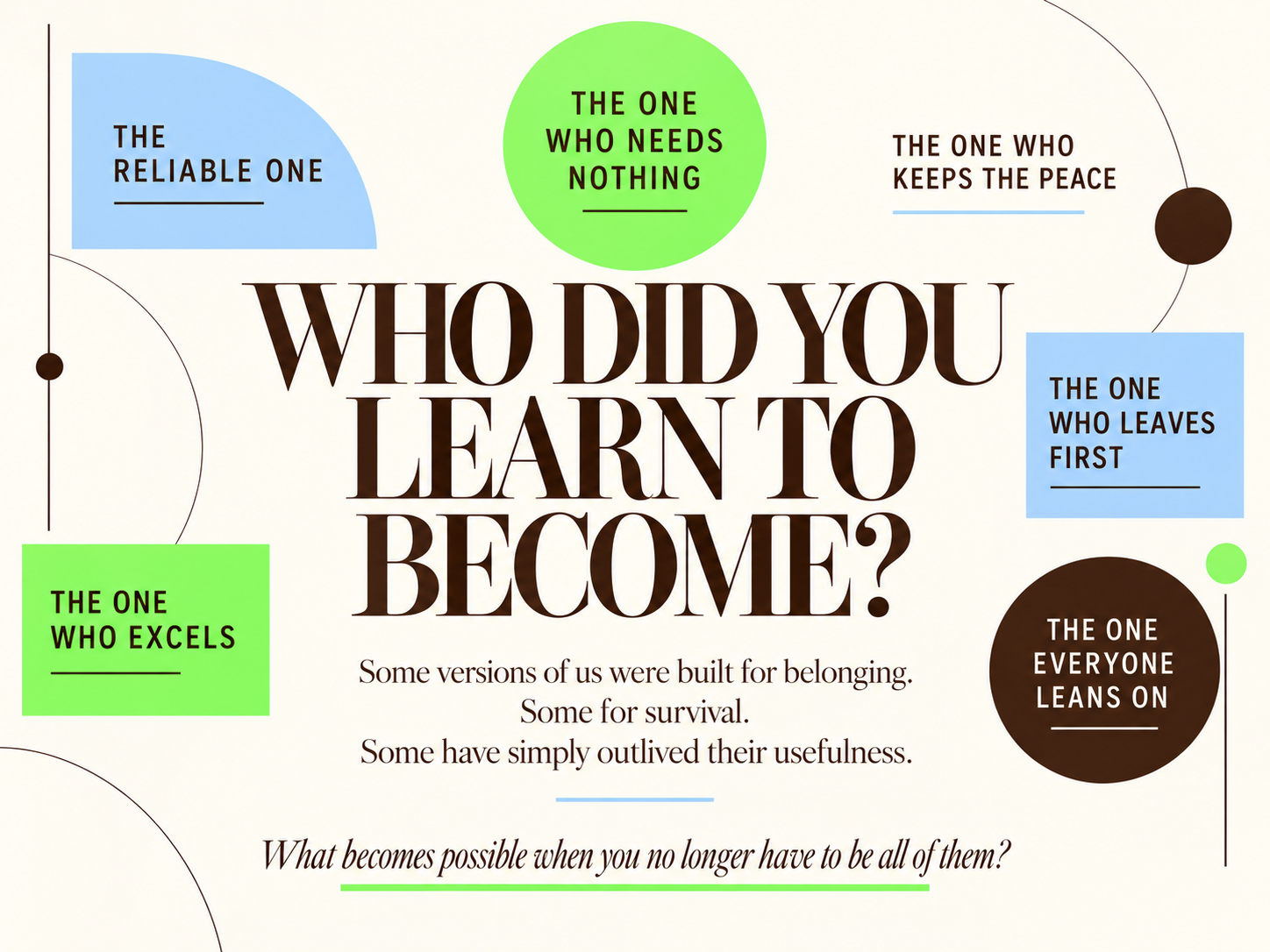
Reading the room. Keeping the peace. Being the reliable one. Achieving. Staying useful. Making people comfortable. Not needing too much. Leaving before we can be left. Holding everything together until we are alone.
These ways of moving through the world rarely come from nowhere. They can grow out of family, culture, relationships, migration, racism, queerness, grief, trauma, faith, survival, or simply years of learning what made it easier to belong.
And sometimes they work really well — until they begin to tip into self-destruction, and you can no longer recognize yourself inside the life you have built.
You can be deeply self-aware and still find yourself overthinking a text message, avoiding a difficult conversation, becoming resentful because you said yes when you meant no, choosing the same kind of relationship again, or feeling guilty the moment you stop being productive.
You can love your family and need distance from them.
You can be grateful for what you have and still want something different.
You can be independent and tired of doing everything alone.
You can understand exactly why you are the way you are and still want more choice.
Therapy gives us somewhere to get curious about the life underneath the coping: what you want, what you fear, what keeps repeating, what no longer fits, and who you might become when you are not constantly organizing yourself around everyone else.
The work is not about turning you into a calmer, more agreeable or more "healed" version of yourself.
It is about building a life that feels more like yours.
How I Work
Narrative therapy is the foundation of my practice. I am interested in the stories we inherit, the stories other people place on us, and the stories we learn to tell about ourselves in order to belong, survive or make sense of what has happened.
Together, we look at how family, culture, migration, racism, gender, sexuality, relationships and power have shaped the meanings you carry.
I also integrate Internal Family Systems (IFS) and parts-based work to explore the different versions of ourselves that can emerge in different relationships and environments — the caretaker, the achiever, the angry part, the part that wants closeness, the part that trusts no one, the person our family expects us to be, and the person we are still becoming.
When practical skills are useful, I draw from Dialectical Behaviour Therapy (DBT) for emotion regulation, distress tolerance, mindfulness, boundaries and relationships. This can be particularly useful for racialized, immigrant, diasporic and third-culture adults navigating family loyalty, individual needs, cultural expectations, code-switching, racism, migration, faith, sexuality and belonging.
My work also includes somatic and body-based practices. We may notice breath, tension, shutdown, movement, sensation or the moment your body responds before you have words for what is happening. We may also use writing, metaphor, imagery, music or other creative practices when talking alone cannot quite reach something.
Therapy with me is active, relational and collaborative. I may ask questions, notice contradictions, return to something you said weeks ago, gently challenge an assumption, or become curious about what is happening between us in the moment.
The work moves between story, body, relationship and practice — helping you understand how you became who you are, while creating more room to decide who you want to be now.
Who I Work With
I provide virtual individual psychotherapy for adults across Ontario, with a particular focus on adults in their mid-20s to mid-40s.
My practice welcomes people of all cultural and religious backgrounds and is particularly attuned to racialized, immigrant, third-culture, refugee, diasporic and queer adults.
You do not need a particular diagnosis, identity or kind of trauma to work with me.
What matters more is whether the way I approach therapy feels useful for what you are trying to understand, change or experience differently.
Starting Therapy
You do not need the right words or a perfectly organized explanation of your life.
You can begin with what hurts, what keeps repeating, or what you want to be different.
I offer a free, no-pressure 15-minute consultation so we can talk briefly about what brings you to therapy, what you are looking for, and whether working together feels like a good fit.