Individual Clinical Supervision
One-to-one supervision tailored to your caseload, stage of practice, professional goals and clinical interests.

Individual, dyadic and group clinical supervision for therapists, social workers and clinicians who want to deepen their clinical thinking, strengthen their judgment and develop a practice that feels genuinely their own.
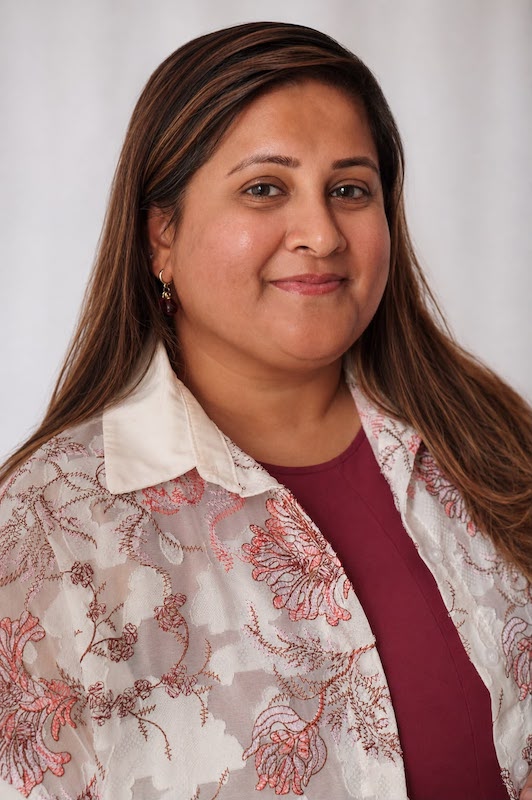
I'm Maheen Hyder (MSW, RSW), a Registered Social Worker, psychotherapist and clinical supervisor with more than a decade of experience across clinical, humanitarian, research and community mental-health settings in Canada and internationally.
I provide virtual clinical supervision across Ontario and can work as a primary supervisor, secondary supervisor or specialized clinical consultant alongside an existing supervisory relationship.
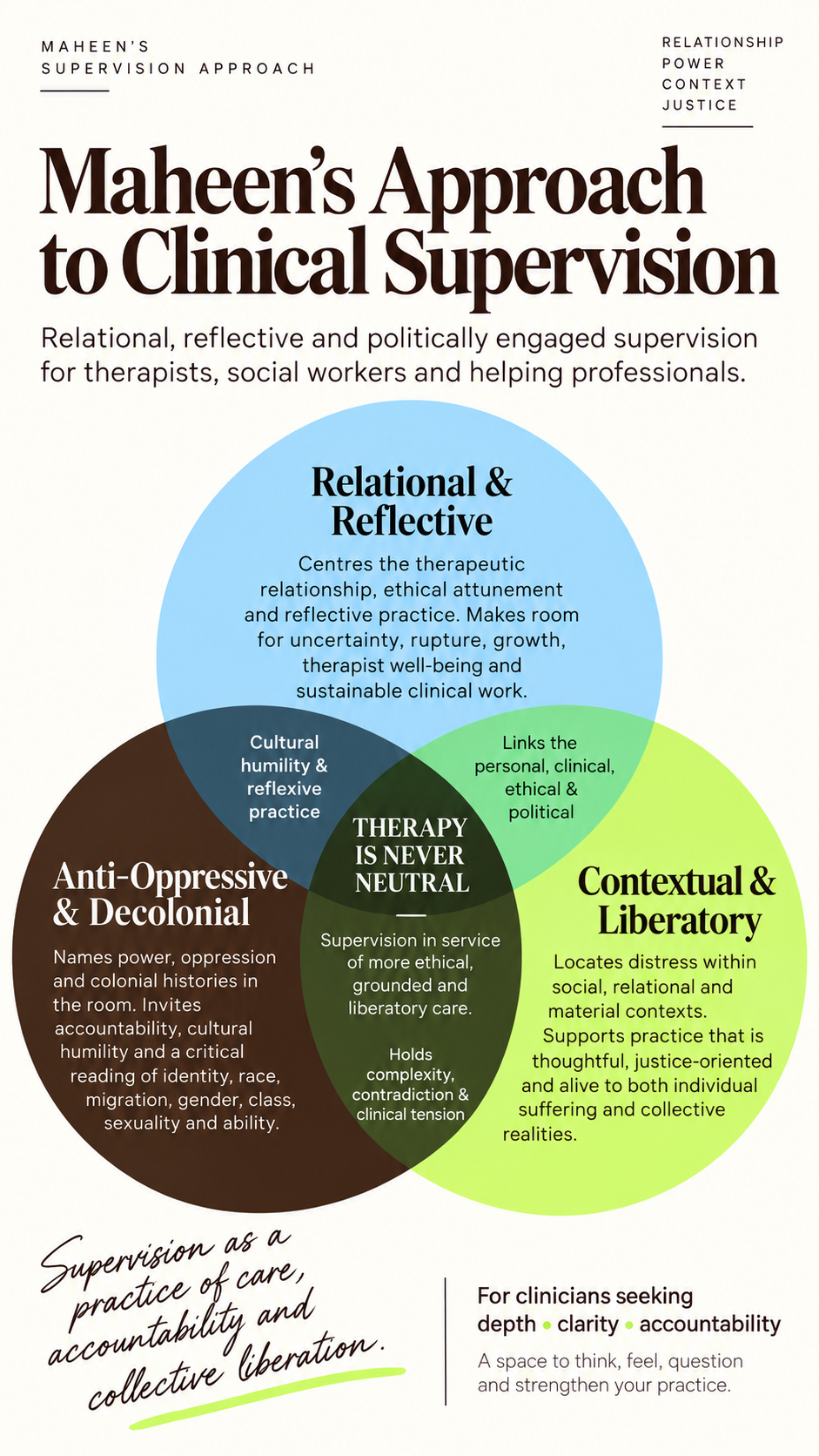
My supervision is relational, direct, collaborative, anti-oppressive, culturally responsive, queer-affirming and politically conscious.
I meet CRPO's current criteria for clinical supervisors and can complete Clinical Supervisor Attestation Forms and verify Direct Client Contact hours when I have the appropriate information to do so. I also provide supervision in accordance with OCSWSSW standards for ethical and competent supervision and psychotherapy practice.
Graduate training can introduce us to theories, modalities and interventions.
Clinical practice eventually asks different questions.
What is actually happening here?
What matters most clinically?
What am I missing?
Why am I choosing this intervention?
What is happening between me and this client?
What do I do when there is no obvious answer?
Supervision with me is less about accumulating techniques and more about developing the clinical reasoning behind the decisions you make in the room.
Together, we slow the work down enough to think about formulation, risk, ethics, relational dynamics, culture and context. We can look at what the client is communicating, what the work is evoking in you, what assumptions may be shaping the formulation, and what intervention actually makes sense now.
The aim is not certainty. It is stronger clinical judgment.
Bring the session you left thinking, I have no idea what I'm doing.
Bring the progress note you have rewritten three times because you are not sure what belongs in the clinical record.
Bring the client you find yourself thinking about long after the session ends.
Bring the intervention that looked excellent in a textbook and landed completely differently in the room.
Bring the client who keeps returning with the same concern and leaves you wondering whether the therapy is actually moving.
Bring the cultural, racial, religious, gender or migration difference you want to think through without stereotyping your client — or pretending difference does not matter.
Bring the moment a client asked you something directly and you were unsure whether to answer, redirect, disclose, challenge or simply stay with what was happening between you.
Bring the ethical question where there is no perfectly clean answer.
And bring the successes too: the session where something shifted, the intervention that worked, the moment you trusted your instincts, or the first time you realized your clinical voice was beginning to sound like your own.
There is room for all of it.
My supervision is warm, direct, relational, reflective and collaborative.
I will tell you what I think you are doing well.
I will also tell you when I think the formulation needs to go further, when something important may be getting missed, or when the clinical, relational or ethical picture deserves another look.
I understand therapy as taking place inside a world.
Race, culture, migration, religion, gender, sexuality, class, family, borders, institutions and unequal access to safety can all shape what enters the therapy room. Attending to those realities does not mean reducing a client to their identities or explaining every experience politically.
It means being able to think carefully about a person's inner world without pretending the world around them is irrelevant.
I am also interested in the theories clinicians inherit: what they help us understand, what they obscure, whose knowledge they privilege, and when the person sitting in front of us asks us to think beyond them.
My clinical thinking is informed by narrative, psychodynamic and relational approaches, Emotionally Focused Therapy, Internal Family Systems, Dialectical Behaviour Therapy, feminist and anti-oppressive practice, trauma-focused psychotherapy and somatically informed work.
I am less interested in asking Which technique should I use? in isolation than in asking:
What am I understanding about this person? Why this intervention? Why now? What am I responding to? What evidence do I have for the formulation I am making?
You do not need to perform certainty with me.
My hope is that supervision helps you become more thoughtful, more accountable, more confident in your judgment and more recognizably yourself as a clinician.
Making sense of complex presentations and developing formulations that actually guide treatment.
Connecting assessment, treatment priorities and intervention with greater clarity and intention.
Understanding what the client evokes in you and what your own responses may be telling us about the work.
Thinking systematically about suicide risk, self-harm, safety planning, clinical responsibility and documentation.
Working through self-disclosure, rescue impulses, avoidance, between-session contact, over-responsibility and difficult relational dynamics.
Writing clinical records that are concise, meaningful, ethical and defensible.
Thinking clinically about race, culture, religion, gender, sexuality, migration, class, family, language and belonging without stereotyping or ignoring difference.
Understanding why an intervention did not land, why the work feels stuck, or what may be happening underneath repetition or disengagement.
Moving beyond performing a modality toward understanding how you think, formulate and practice.
Identifying the clinical areas, populations and questions toward which your interests and expertise are developing.
Refugee and newcomer mental health is one area of specialized supervision I offer.
Working with refugee claimants, asylum seekers and people affected by forced migration can require clinicians to think simultaneously about trauma, displacement, culture, language, family separation, political violence, legal uncertainty and the conditions of resettlement itself.
These realities can affect disclosure, memory, assessment, risk, treatment planning, documentation, trust and the therapeutic relationship.
My experience in this area includes nearly six years providing specialized psychotherapy through Canada's Interim Federal Health Program, alongside broader work in refugee mental health, humanitarian settings, torture rehabilitation, interpreter-mediated care and clinical documentation.
Specialized consultation can include:
The goal is not to learn a checklist for "working with refugees."
It is to strengthen the clinical judgment required when trauma, culture, migration, language, power and legal uncertainty are all relevant at the same time.
You may be looking for a primary supervisor, additional support alongside an existing supervisor, help thinking through a particular area of practice, or simply a place where your clinical thinking can become deeper and more intentional.
You do not need to wait for a crisis or an especially complicated case to use supervision well.
One-to-one supervision tailored to your caseload, stage of practice, professional goals and clinical interests.
Supervision shared by two clinicians, allowing for individual case consultation alongside collaborative learning.
A shared space for case consultation, clinical reasoning, reflection and professional development.
I can work as a primary clinical supervisor or as a secondary or specialized supervisor alongside an existing supervisory relationship.
You do not need to know exactly what kind of supervision you need before reaching out.
We can talk about your current practice, the kinds of cases or questions you are carrying, your regulatory requirements, and what you want supervision to help you develop.
Bring the case you cannot stop thinking about.
Bring the question you are embarrassed to ask.
Bring the place where your training stopped being enough.
Bring the clinician you are becoming.
We can start there.